













Before I get into the analysis an review of this book, I want to say that this was absolutely torture to read. If you are sensitive to gross stuff, like “poison bread, dead rats,” then this review and book are not for you. A couple of weeks ago in my US History class, we read Chapter 14 as an excerpt instead of the entire novel–thank god for my classmates. But I was curious, so I decided to read more, and now I regret it. Since then, I’ve never looked at a rack of ribs, a steak. Or even a cheeseburger with love or strong desire to eat it. Instead, I’d rather just eat a salad and call it a night.
Upton Sinclair did a good job writing it; he didn’t sugarcoat anything. By “sugarcoat,” I mean he didn’t make it seem like the meat was a little bit rotten but still okay to eat if you were hungry. No, it was exactly how it was– raw and disturbing. If I were Upton, and imagining that he had eaten meat all the time, I would probably convert to veganism and pray that the steak I had for dinner two nights ago wouldn’t catch up to me. I kid you not, I even skipped lunch that day. I couldn’t eat the dry chicken sandwich or anything else because the thoughts from what I read in class were etched in my mind. It was gross. But also kind of interesting.
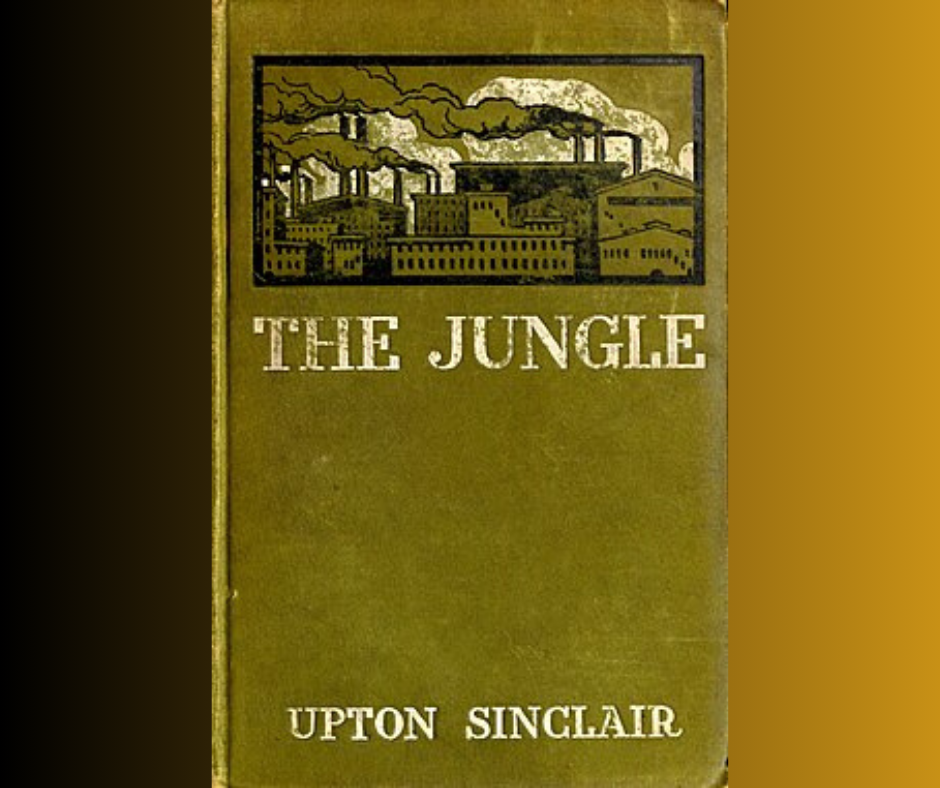
Also, before I get into the nitty-gritty, The Jungle is a novel by an American author and journalist, also known as a “Muckracker” for his efforts to expose corruption in the government and business in the early 20th century. In 1904, Upton spent seven weeks gathering information while working incognito in the meatpacking plants of the Union Stockyards in Chicago for a socialist newspaper Appeal To Reason, which was published in his novel in serial form in 1905.The book realistically depicts working-class poverty, immigrant struggle, lack of social support and welfare, harsh living and dangerous working conditions, generating hopelessness or cynicism and cruelty among the powerless. These elements are contrasted with deeply rooted corruption of people in power. A review by Upton’s contemporary, writer Jack London, compared The Jungle to America’s famous novel written to expose a cruel system, by calling it “The Uncle Tom’s Cabin of wage slavery.”
While Sinclair has described the meat industry and its working conditions as wanting to advance socialism, the novel’s most immediate impact was to provoke the public outcry over passages exposing health issues and unsanitary practices in American meat-packing industries during the early 20th century. This led to sanitation reforms including the Meat Inspection Act, to which had been signed by Teddy Roosevelt, and other product safety legislation. The basis of the plot revolves around a young man, Jurgis Rudkus, who is a Lithuanian immigrant, and his family who struggle to survive in terrible living and working conditions, but mainly a novel about the brutal lives of immigrants like Jurgis in Chicago’s meatpacking industry, revealing the shocking and unsanitary conditions in those stockyards. Also, before I get into this review, I’m inspired by Upton because he used his writing to uncover and expose real problems that people were facing, especially those who did not have a voice to speak out against them, or further investigate those issues and uncover the dark truth for the entirety of America to see, and make a difference by spreading public awareness. His courage to speak out and reveal harsh truths about the meatpacking industry not only raised awareness but also led to important changes that helped protect workers and consumers.That kind of impact through storytelling shows how truly powerful words can be, and it motivates me to look deeper into the stores behind history and how they have shaped our world today.
As I was reading, the first thing I noticed was how I thought It was kind of strange how Jurgis, a mid-20-year-old, and Ona, who is just shy of 16, were getting married, but that isn’t the most important thing. Also, I took parts from the original and compared it to the modified version, and I’m surprised to say the least that there were things that had been left out of the modified version, which was the original book (though the censored version was horrific enough), needless to say, I mostly regret reading the entirety of the book, but also glad I had the chance to read it at the same time. While reading, I can imagine vegans having a sheer and utter stroke, even though it’s kind of an animal rights book as well, because of the vivid descriptions and harsh realities Sinclair presents, not just of the treatment of immigrant workers, but the animals also. I was interested to know what animal activists think of this book, so I decided to do some research on that, and I think it’s odd that some activists focus mostly on the animal cruelty aspects but don’t always highlight how Upton also exposes harsh working conditions for the people in the industry, and all of the horrible, gut-wrenching things that go into that meat, to which the industry smacking labels on, selling it and profiting from it.
When researching, I found that animal rights activists are often asked, “Why don’t they help humans before animals.” Animal Liberation author, Peter Singer said it best: “There is nothing to stop those who devote their time and energy to human problems from joining the boycott of the products of agribusiness cruelty. It takes no more time to be a vegetarian than to eat animal flesh. In fact…those who claim to care about the well-being of human beings and the preservation of our environment should become vegetarians for that reason alone.”Also, in The Jungle, Upton likewise demonstrates the links between animal rights and human rights. While researching, I also found a few industries more abusive to human workers than factory farms. The undercover footage we see of workers abusing animals and workers is absolutely repulsive and appalling, and obviously, there is never any justification for this sort of cruelty–but would this have happened if these workers had decent conditions in which to work, if they were treated with any dignity at all themselves? It should not take a degree in psychology to know that abuse only leads to more abuse.
In the novel, Upton portrays this well. Yet, while things have certainly improved when it comes to food safety, reading The Jungle brings to mind some of the human and animal abuse still going on today. This quote, for example, could have been written about a factory farm of the twenty-first century: “That day they had killed about four thousand cattle, and these cattle had come in freight trains, from far states, and some of them had gotten hurt. There were some with broken legs and some with gored sides; there were some that had died, from what cause no one could say; and they were all to be disposed of here in darkness and silence.” Upton, while mainly focusing on the issues of immigrant workers who did not have a lot of money, was not at all blind to the suffering of animals. “Each one of those pigs was a separate creature,” he wrote. “Some were white pigs, some were black; some were brown, some were spotted; some were old, some were young; some were long and lean, some were monstrous. And each of them had an individuality of his own, a will of his own, a hope and a heart’s desire; each was full of self-confidence, of self-importance, and a sense of dignity. And trusting and strong in faith he had gone about his business, and a horrid Fate waited in his pathway.”
It’s impossible not to be moved and grossed out by this book, and even if you have read it before, like me, out of curiosity, it’s worth revisiting one day in the future. As disgustingly groundbreaking as it was back in the early 20th century, the Jungle still feels disgustingly groundbreaking today, despite what generation you come from, as it tackles issues that are, unfortunately, all-too-relevant; the abuse of factory workers, and the abuse of animals at the rough hands of not only workers, but even more so of the corporations that keep these factories up and running. As Upton writes, “… murder it was that went on there upon killing-floor, systematic, deliberate and hideous murder—and there was no other word for it, and nothing else to be said about it. They were slaughtering men out there, just as certainly as they were slaughtering cattle; they were grinding the bodies and souls of them, and turning them into dollars and cents.”
I want to specifically talk about Chapter 14 because it focuses on the dark side of capitalism and industrialization. The things I have read in this chapter have totally driven home the shocking reality of the meatpacking industry at the time. The way Upton describes the family witnessing horrors like repackaging spoiled meat and poisoned rats being grounded up into sausage is both disgusting and eye-opening. Ever since I read the part about using everything from the pig but the squeal in US History, I couldn’t stop thinking about what that really meant, although that line made me squirm a little in my desk at the thought of how brutal and wasteful it was.What struck me the most was how the family slowly falls apart under these brutal conditions to which they had endured. They’re exhausted, emotionally drained, and losing any sense of joy or hope. The fact that they’re too beaten down to even feel hunger pains, despite starving, is a powerful image of their suffering. Jurgis turning to alcohol to feel alive, and Ona’s emotional breakdowns, make their struggles feel so real and heartbreaking. It’s clear that the American Dream they chased is slipping away, replaced by a harsh fight just to survive. In my opinion, I think Jurgis and his family’s struggles show social Darwinism because they were treated like only the strongest deserved to survive, while the weak were left to suffer without help.
But, referring to what I’ve said before, it isn’t solely about the animals being abused; It’s about the people too. Jurgis, being a man, faces his own hidden battles–he turns to drink, a struggle he barely will admit to himself. The way Upton writes that Jurgis’s christmas bells aren’t ringing for him, that he’s thrown aside like ‘a bit of trash, the carcass of some animal,’ really makes you think how utterly heartbreaking to see how no one counts him, even while his family is starving and suffering. When Jurgis is sentenced to thirty days in jail and cries out about his family starving, it shows just how trapped and desperate he is. Now, I want to dive into the aftermath and the public outcry that followed the book.
When Upton published The Jungle in 1906, the novel had quickly become a sensation because of the horrifying and unsanitary conditions in America’s meat-packing industry being exposed to the public. His vivid, stomach-turning descriptions of the stockyards and slaughterhouses shocked readers and ignited a powerful movement for pure food reform, leading to the swift passage of landmark food safety laws. But the story behind the book is just as compelling. Two years before publication, in the fall of 1904, Sinclair, then a 26-year-old devoted socialist, traveled to chicago to gather material for what he hoped would be the Great American Novel. Like I’ve said before, for roughly seven weeks, he immersed himself undercover in Chicago’s “Packingtown,” a sprawling and grim complex of stockyards, feedlots, slaughterhouses, and meat-packing plants. Based on my research, I read that Sinclair dressed in grimy clothes and carried dinner pails to blend in, witnessing firsthand the dangerous and oppressive conditions endured by what he called “the wage slaves of the Beef Trust.” The experience horrified him and fueled his determination to disclose the truth to the public.
The Jungle was meant as a metaphor for capitalism’s brutal effects and originally appeared in monthly installments throughout 1905 in the socialist newspaper Appeal to reason. Initially, The Jungle had a limited audience, but when Doubleday, Page & Company published a revised version in February 1906, it skyrocketed to bestseller status, selling over 150,000 copies in its first year. Sinclair hoped the book would ultimately spark outrage about “wage slavery” and inspire support for socialism, much like how Uncle Tom’s Cabin had influenced the national conversation about slavery decades earlier. What really stands out to me is how even Teddy Roosevelt acknowledged the severity of the situation, saying conditions were “more than I had imagined or believed possible.”
That kind of response from the president shows just how deeply the book impacted people at all levels. However, Upton makes an interesting point that the book “hit the head and not the heart.” What I think this means is that while The Jungle successfully raised awareness and provoked action on food safety, It didn’t quite inspire the emotional connection or empathy for the workers’ struggles that Sinclair originally intended. Instead of focusing on the human suffering of the workers, the public and lawmakers zeroed in on the unsanitary conditions and consumer protection. This shows how sometimes the message people can take away from it can be different from what the author had hoped for. The public outcry that followed was massive, pushing lawmakers to act quickly. The Meat Inspection Act and the Pure Food and Drug Act of 1906 were direct results of the outrage Sinclair’s novel had stirred up. While Upton had originally intended the book to spotlight the struggles of workers and promote socialism, the immediate effect was much more focused on food safety and consumer protection. I think this shows how a single work of art or writing can have unexpected but important consequences.
Overall, The Jungle reminds me that sometimes the most effective way to create change is by telling stories that make people feel the reality of a problem, not just hear about it. It’s a powerful lesson in how awareness can lead to action, and it makes me appreciate the role of writers and journalists in shaping history. It also reminds me of how muckrakers like Upton Sinclair add to my inspiration of going into investigative journalism in the future. Their courage to dig deeper, exposing the truth whether good, bad, or ugly, challenging powerful interests shows how journalism can be a force for good in the world. Thinking of it this way motivates me to use storytelling to inform, but inspire real change too, exactly like Upton had done with The Jungle.